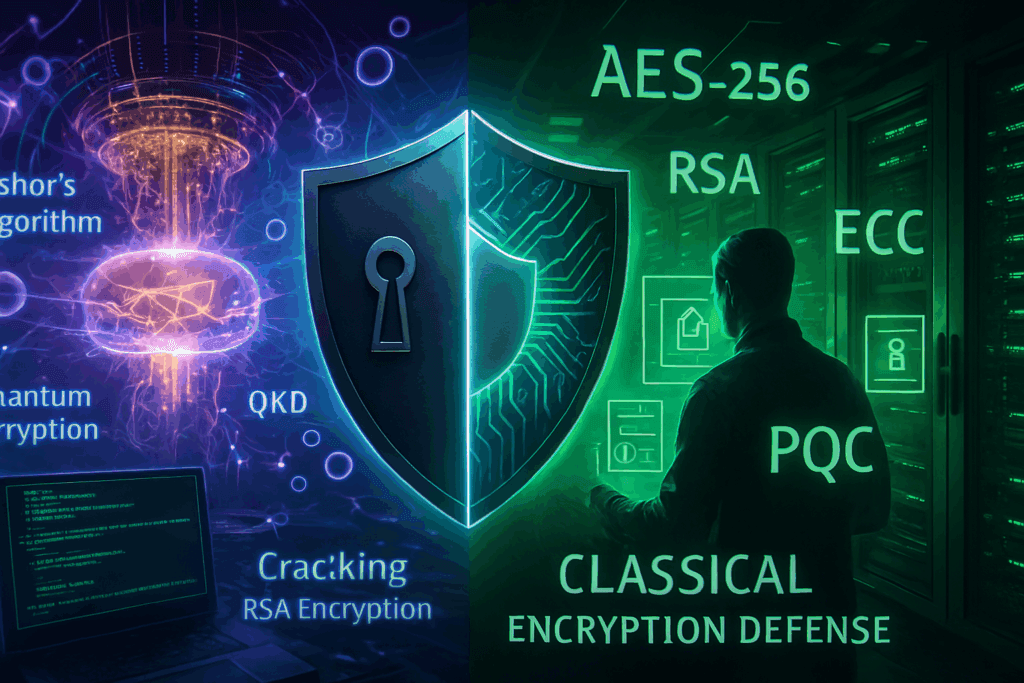
Quantum-Safe Encryption 2025 has become a critical cybersecurity priority as quantum computing threatens classical encryption methods like RSA and ECC. For years, encryption methods like RSA and ECC have relied on mathematical hardness, such as factoring large numbers or solving discrete logarithms, to secure digital communications.
But Shor’s algorithm, formulated in 1994, unlocks a quantum-powered way to solve these problems efficiently, posing a direct threat to existing encryption systems.
How soon might this threat arrive? Estimates vary: many experts forecast that 5–10 years before quantum-capable machines (thousands of logical qubits) can crack RSA‑2048. Because of “store now, decrypt later” threats, the urgency to adopt quantum-safe encryption is already here.
Encryption at a Glance: Classical vs. Quantum-Safe Encryption
Quantum-Safe Encryption 2025: Vulnerabilities & Standards
How Shor’s Algorithm Undermines RSA/ECC
Shor’s algorithm can factor large integers or solve discrete logarithms in polynomial time, efficiently dismantling RSA and ECC security. While experimental implementations have factored trivial numbers (like 21), scalable systems will require thousands of logical qubits. Ongoing algorithmic optimizations continue to reduce overhead, making early migration strategic.
NIST & Industry Response
- NIST’s PQC competition: launched in 2016; first standards (CRYSTALS‑Kyber, Dilithium, SPHINCS+) finalized Aug 2024
- HQC selected Mar 11, 2025, as backup KEM; draft FIPS out by 2026, finalized by 2027
- Industry experiments: banks like LGT and NXP are testing already; organizations across TLS, mobile apps, and chip firmware are starting pilots
Preparing for Quantum-Safe Encryption 2025 Reality
1. Inventory & Risk Assessment
- Map all systems using RSA/ECC, including legacy and external libraries.
- Apply Mosca’s theorem: If data confidentiality must hold longer than the time to migrate plus the time until Q‑Day, you’re vulnerable now
2. Experiment with PQC Now
- Run pilot implementations for Kyber, Dilithium in TLS stacks or secure messaging.
- Leverage hybrid key-exchange models—classical + PQC in parallel—to future‑proof connections.
3. Plan Migration Timelines
- Follow guidelines: complete migration for critical infrastructure by 2030–35 .
- Integrate PQC in hardware and firmware—chip-level support prevents patch-only vulnerabilities .
4. Monitor Standard Updates
- NIST timelines: HQC finalized by 2027, more drafts to follow
- Keep tabs on FIPS/SP/PQC updates and vendor implementation roadmaps.
Conclusion: Why Quantum-Safe Encryption 2025 Is Urgent
Quantum powered decryption sometimes dubbed Q‑Day isn’t science fiction; it’s a slowly approaching reality. With Shor’s algorithm threatening RSA and ECC, the shift to quantum-safe encryption algorithms in 2025, like Kyber, Dilithium, SPHINCS+, and soon HQC, is no longer optional—it’s urgent.
For Cybersecurity pros and tech leaders: Begin PQC pilots this year, update key‑exchange libraries, and create long-term migration roadmaps. For privacy aware consumers: Seek out apps, websites, and services that already support PQC or hybrid encryption, especially when handling long-lived or highly sensitive information. For students and tech watchers: Dive into lattice‑based cryptography, learn quantum development tools like IBM Qiskit, and follow NIST’s ongoing standardization progress.
Quantum Safe Encryption 2025 is not just a buzzword it represents the next generation of digital trust. Organizations must understand that today’s encrypted data may be harvested and decrypted tomorrow. This makes “store now, decrypt later” threats very real and very present.
In short, post‑quantum cryptography isn’t just a theoretical milestone it’s a strategic imperative. The best time to prepare was yesterday. The next-best time is now.