Imagine this: It’s 7:00 PM, your hands are full, and dinner’s on a tight schedule. You tell your Samsung SmartThings oven to preheat via the app, but it won’t connect. Meanwhile, your LG ThinQ fridge has sent five notifications about low milk and a half-used cucumber. And the dishwasher? The app crashed again mid-cycle. Welcome to the modern “smart kitchen,” where appliances talk a lot, but don’t always do their job. Smart Kitchen Appliance Problems 2025 are frustrating tech-savvy users and everyday cooks alike, as Samsung and LG’s high-tech promises unravel in real-world kitchens.
Integrated smart kitchens are sold as the future of home living. But beneath the shiny screens and Wi-Fi features lies a pile of overpromises, clunky interfaces, and connectivity issues. While tech giants like Samsung and LG pitch their ecosystems—SmartThings and ThinQ—as seamless smart home hubs, reality shows they’re often more frustrating than functional.
In this article, we’ll break down the overhyped dream of smart kitchen appliances, compare Samsung vs LG vs traditional models, and help you decide whether the smart kitchen trend is actually… smart.
Smart Kitchen Appliance Problems 2025: What the Ads Don’t Tell You
Samsung’s SmartThings and LG’s ThinQ promise a connected kitchen where your fridge suggests recipes, your oven preheats from your phone, and your dishwasher tracks detergent levels. The idea is seductive—automate the mundane, save energy, and impress your dinner guests.
Here’s what they market:
- Remote control of appliances via an app
- AI-powered food recognition and cameras inside fridges
- Voice commands through Alexa or Google Assistant
- “Interoperability” across appliances via the Home Connectivity Alliance
And the market is certainly buying it—for now.
- According to Persistence Market Research, the smart kitchen appliance market is growing at an 8.4% CAGR, projected to reach $3.2 billion by 2030.
- Another forecast puts it even higher: $61.6 billion by 2030 with an 18.6% CAGR.
But here’s the catch: hype doesn’t equal happiness. “Smart” doesn’t always mean better, especially when connectivity fails, apps crash, or you need a manual just to run the dishwasher.
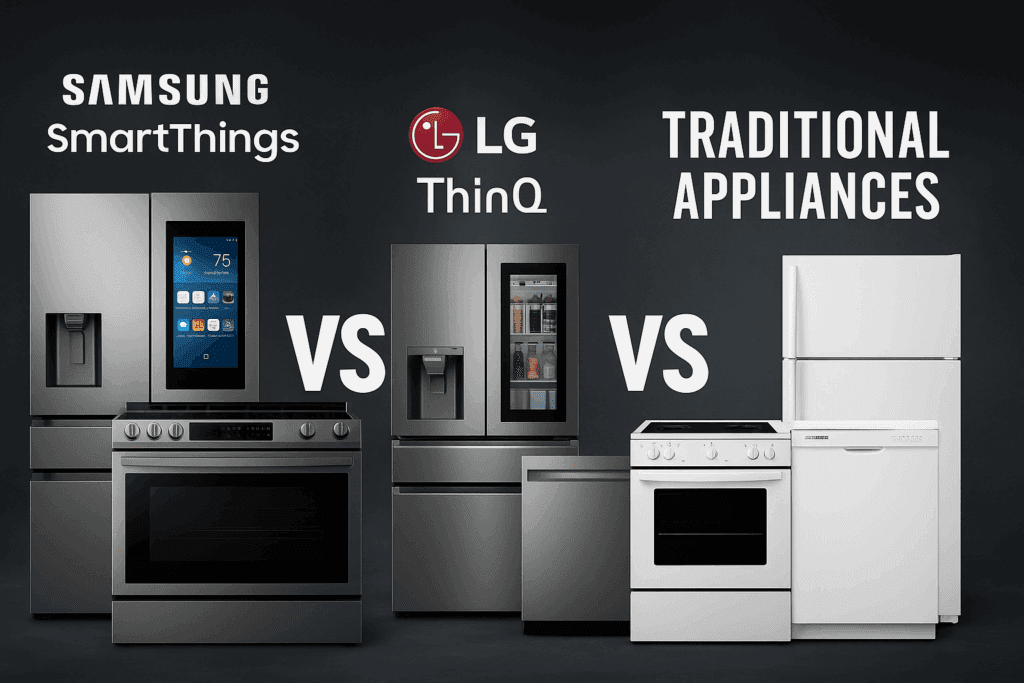
Comparison Table: Samsung vs LG vs Traditional Appliances
| Feature/Issue | Samsung SmartThings | LG ThinQ | Traditional Appliances |
| Connectivity Reliability | Spotty (frequent drops) | Moderate (some lag issues) | Always-on (no Wi-Fi needed) |
| Ease of Use | Complex UI, many steps | Slightly simpler but glitchy | Straightforward buttons/knobs |
| Privacy & Data Use | Tracks user behavior | Tracks user behavior | No data collection |
| Cost | $$$ – Often $2,000+ | $$$ – Similar pricing | $ – Often half the price |
| Repair & Support | High service rates (Yale) | App obsolescence risk | Easier to repair |
| Learning Curve | Steep | Moderate | None |
| Voice/App Integration | Yes (SmartThings, Alexa) | Yes (ThinQ, Google) | No |
| Longevity | Dependent on app support | Vulnerable to software decay | Long lifespan |
Smart Kitchen Appliance Problems 2025: Connectivity Chaos: When Your Oven Won’t Listen
Smart appliances live and die by Wi-Fi. And sadly, their connectivity can be… dumb.
The Samsung Family Hub fridge, for instance, frequently drops Wi-Fi, causing missed alerts or broken app sync. LG’s ThinQ ovens often lag or fail to execute commands. A 2022 Consumer Reports survey revealed:
“While 21% of Americans own smart appliances, nearly 47% express concerns over privacy, app reliability, and network dependency.”
These apps aren’t built like smartphones—they often crash, take too long to respond, or simply stop working after updates. These are the kinds of Smart Kitchen Appliance Problems 2025 consumers didn’t expect when they upgraded their homes. Add to that:
- App bloat (multiple apps per brand)
- Compatibility issues with older Wi-Fi routers
- Slow firmware updates (if they arrive at all)
And imagine explaining all this to a hungry toddler waiting for dinner.
Overhyped Interfaces & Smart Kitchen Appliance Problems 2025
User-friendly? Not quite.
Reddit threads like r/appliances are flooded with people complaining about the complexity of smart appliance interfaces:
- Samsung’s Bespoke fridge interface is “a labyrinth” for some users.
- LG’s QuadWash dishwasher has cycle options buried under menus that few people understand.
- Touchscreens get greasy fast and are hard to navigate mid-cooking.
For older users or those less tech-savvy, smart kitchens can be alienating. While turning a knob or pressing a button takes seconds, smart apps require:
- Account registration
- App download + device pairing
- Network setup + syncing
- Constant updates
It’s the digital equivalent of needing a pilot’s license to make toast.
The Overhyped Extras: Cameras, Recipes, and Voice Drama
Many smart appliance “innovations” feel more like gimmicks than game-changers.
- Fridge cameras? Looks fun, but most people can open the door.
- Recipe sync from app to oven? Adds complexity, rarely works perfectly.
- Voice control? Shouting “PREHEAT TO 375” doesn’t always feel easier.
And then there’s the cost.
The Samsung Bespoke Fridge starts at around $2,300, while a traditional, reliable fridge costs under $1,000. Worse, Yale Appliance reports Samsung products have higher-than-average service call rates, leading to expensive maintenance over time.
Meanwhile, many “smart features” go unused. In a 2025 PCMag review, nearly 60% of users said they disabled smart functions within the first year.
Your Dishwasher Might Be Watching You: Privacy and Security Woes
Every smart device is a data collector, and kitchen appliances are no exception. According to Consumer Reports, Samsung and LG’s apps track:
- Appliance usage patterns
- Door open/close frequency
- Meal and recipe preferences
Some of this data may be shared with partners or used for ad targeting. Worse, only 3 out of 21 appliance brands clearly state how long they’ll support software and security updates.
Without updates, your “smart” dishwasher becomes a ticking Security Risk an open door for hackers, quite literally.
Why Simpler Is Smarter
Here’s the irony: the more advanced the appliance, the more fragile it becomes. Traditional kitchen appliances:
- Last longer (fewer parts to fail)
- They are easier and cheaper to repair
- Don’t require cloud connections
- Aren’t collecting your data
Most importantly, they just work. No apps. No updates. No headaches.
And according to user trends, more and more people are turning back. A 2024 nationwide survey by Statista found:
“43% of homeowners with smart kitchen appliances admitted to disabling features or never using them after six months.”
Conclusion: Are Smart Kitchen Appliance Problems 2025 Avoidable?
Smart kitchen appliances, especially from brands like Samsung SmartThings and LG ThinQ, are marketed as the next big thing. But in practice, they often create more problems than they solve.
From flaky connections to unnecessary features, complex interfaces, high prices, privacy concerns, and disappointing longevity, it’s fair to say the integrated smart kitchen trend is overrated.
Unless you enjoy debugging apps and updating firmware to make toast, a traditional appliance might just be the smarter choice. If you want fewer headaches, steering clear of Smart Kitchen Appliance Problems 2025 may be the best decision you make in your kitchen.
Because let’s be real—if your fridge needs to remind you about milk, maybe the problem isn’t the fridge.
Quick Takeaways
Are smart kitchen appliances worth it?
Only if you love tech and don’t mind bugs. For most people, traditional appliances offer more value, simplicity, and peace of mind.
What are the biggest problems with Samsung and LG smart appliances?
Unreliable app connectivity, high service costs, privacy concerns, complex interfaces, and software update issues.
Is it better to go with non-smart kitchen appliances?
Yes, especially if you prefer reliability, ease of use, and long-term cost savings.